
The glorious sunshine we have been enjoying recently has set a wonderful backdrop as we head into the busiest holiday booking period of the year. The countryside is looking glorious and our local towns and villages are buzzing with visitors. But behind the scenes of a busy summer, what does the macroeconomic data actually tell us about the health of the holiday let market – and how can owners protect their long-term yields?
Navigating a Competitive Summer Market
Across the wider UK holiday let industry, summer demand has remained resilient. More guests are booking further in advance than last year and average daily rates are increasing, though overall occupancy and length of stay have remained broadly flat nationwide.
However, as the peak weeks progress, we are seeing increased discounting from many corporate, non-specialist agencies desperately competing for late bookings. While this panic-discounting is putting downward pressure on rates across the industry, our focus at Bolthole Retreats remains entirely on achieving the best possible balance of occupancy and revenue for our owners.
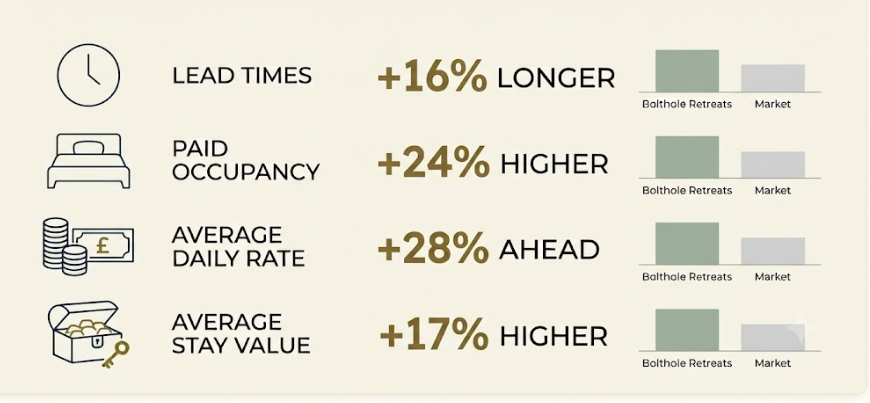
By avoiding knee-jerk price slashes and focusing on hyper-local marketing, Bolthole Retreats continues to significantly outperform the wider market. According to recent regional data:*
- Stay Value: This balances out to an average total stay value that is 17% higher for our owners.
- Lead Times: Our booking lead times are 16% longer than the market average, giving our owners income predictability much earlier.
- Paid Occupancy: Our targeted local visibility keeps our paid occupancy rates 24% higher than the competition.
- Average Daily Rate (ADR): Our strategic, dynamic pricing keeps our ADR 28% ahead of the market.
(Source: Key Data Dashboard, tracking 147 property managers and 4,952 properties across our operating regions.)
A “Quality First” Market: Navigating Recent Tax & Booking Shifts
It is no secret that the broader landscape for holiday homeowners has shifted. Following the recent removal of traditional furnished holiday let tax advantages and the roll-out of council tax premiums on second homes across parts of the UK, the raw volume of holiday lets in England has experienced a slight squeeze.
However, this is not a market in decline; it is a market becoming more selective. Demand has not disappeared, it has simply concentrated into premium, internationally recognised destinations, like the Cotswolds and the West of England. The latest Airbnb UK Summer Travel Forecast highlights a massive year-on-year surge in searches for rural countryside retreats, specifically naming Herefordshire (up 76% in search growth) and the Forest of Dean District (up 34% in search growth).
Furthermore, guest booking habits are evolving. Instead of committing to a single, expensive overseas holiday, 2026 travellers are increasingly spreading their travel budgets across two to three shorter, higher-quality domestic breaks throughout the year. The YouGov UK Summer Travel Report reveals that 19% of travellers are actively swapping international trips for domestic staycations to manage inflation – a figure that rises to 21% among families. The Barclays Consumer Spend Index confirms this clear shift, driven by a consumer preference for flexibility, comfort, and financial predictability closer to home.
Because guests are taking more frequent, intentional trips, they are looking for premium, friction-free experiences. For owners, this means that partnering with a professional agency that utilises agile data tools and localised marketing is no longer just a luxury. It is now the baseline required to navigate new overheads and protect your returns.

The Truth Behind the “Visitor Levy” Headlines
You may have also seen recent news regarding the proposed Overnight Visitor Levy (often called a “tourism tax”) for holiday accommodation in England. In light of the framework moving through consultation, we want to provide some clarity on where this policy actually stands for our community.
Crucially, under the proposed framework, the power to introduce a visitor levy will only be granted to Mayoral Combined Authorities and devolved regional leaders—not individual district or county councils. Furthermore, implementing a levy is not automatic; it requires local authorities to choose to introduce one after a formal local consultation process.
Because Gloucestershire (including the Cotswolds and Forest of Dean), Herefordshire, and Wiltshire do not have a mayoral governance structure, there is currently no mechanism for local councils in our operating areas to introduce a visitor levy.
We are monitoring the legislation closely and will instantly update our owner community if anything changes. In the meantime, our priority remains clear: keeping your calendar full, your rates high, and your investment completely protected.